

What is Content Marketing?
To understand Content Marketing meaning, we need to know that it is a process which involves a well thought out marketing approach focused on creating, publishing, and dispensing content for a targeted audience online.
The content produced is valuable, relevant, consistent, and engaging with an aim to attract and increase engagement with the audience or users.
It is considered as one of the most powerful tools for businesses to connect with their customers. It assists in establishing and fostering relationships with their customers. It gives more importance to the audience compared to the brand, product or services, by creating informative content for them.
What is the purpose of Content Marketing?
The sole purpose of it is to attract, engage, and retain a targeted audience. In order to attain that it uses digital assets like text, images and videos, etc.
What are the types of Content Marketing?
Some of the common and popular types are as follows-
1. Blog
It is a website where individuals or groups or businesses regularly publish long-form content on various topics in an informal and conversational style. They are known as Posts. Blogs can be personal or professional focusing on areas of interest. Blog posts are a powerful means to bring valuable, engaging content to your target audience.
2. Social Media
It is one of the most dynamic types of content marketing.
Social media comprises different platforms, for instance, Facebook, Instagram, LinkedIn, etc., and different audiences on those platforms. So businesses can customize their content by platform, utilize various media and direct traffic to their website from their posts.
3. Infographics
These are visual representations of data information. They tell a story by combining text and visuals (images, graphs, icons) and results in making the complex content engaging and easy to understand.
4. Videos
Businesses create videos to promote their brand. Online videos lead to conversions, as they not only engage people but can be used to educate consumers turning passive visitors into customers.
5. Podcasts
It can be understood as an episodic series (organized into series, similar to TV shows) of digital audio or video files, available online, letting people listen to various topics anytime. It builds deep audience connections, reaching listeners who prefer audio over text or reading. It is very much in demand as a user can choose when and where to listen/watch, and are considered as one of the most important type of content marketing.
6. E-Books
These are long-form content which provides in-depth and detailed information and solutions to audience problems. They are utilized to endorse a product or service.
7. Case Studies
These are detailed, in-depth, evidence-based narratives that act as crucial social proof to build trust and authority as they showcase how a product or service solved a specific client’s problem.
8. Emails
It is a digital method of exchanging messages, files, and documents between people over the internet or a computer network. The strategic use of email is to distribute relevant, valuable content to a targeted audience, aimed at building relationships, nurturing leads, and fostering customer loyalty.
9. Memes
Memes are the most popular type of content marketing and can be understood as images, videos, piece of text, etc., typically humorous in nature. The use of memes relies heavily on reliability and humor to engage a target audience. Brands often share or create memes to tap into current online culture which helps them to connect with younger generation who are more likely to use and share memes on social media platforms.
10. Interactive Content
It is a type of digital material that requires active user participation rather than passive viewing. Interactive content- such as quizzes, calculators, polls, and interactive videos- transforms passive consumers into active participants, resulting in boosting engagement, lead generation, and data collection.
What are the benefits of Content Marketing?
In today’s age, we know that content is king. Also, nowadays, more and more customers are discovering new brands and products online, and customers expect consistent, high-quality, and engaging content from their brands. So, it is very beneficial and thus the benefits are as follows-
- It helps businesses build brand awareness.
- It educates the audience.
- It establishes brand authority and builds trust and credibility.
- It assists in generating high-quality leads.
- It drives more sales and revenue.
- It fosters customer loyalty.
- It enhances SEO.
- It assists in getting higher organic traffic.
- It leads to increased conversions, i.e., helps in converting visitors into customers.
- It is cost-effective compared to traditional advertising.
What are the 7 C’s of Content Marketing?
The below mentioned 7 C’s provide a layout to create a content that derives meaningful results.
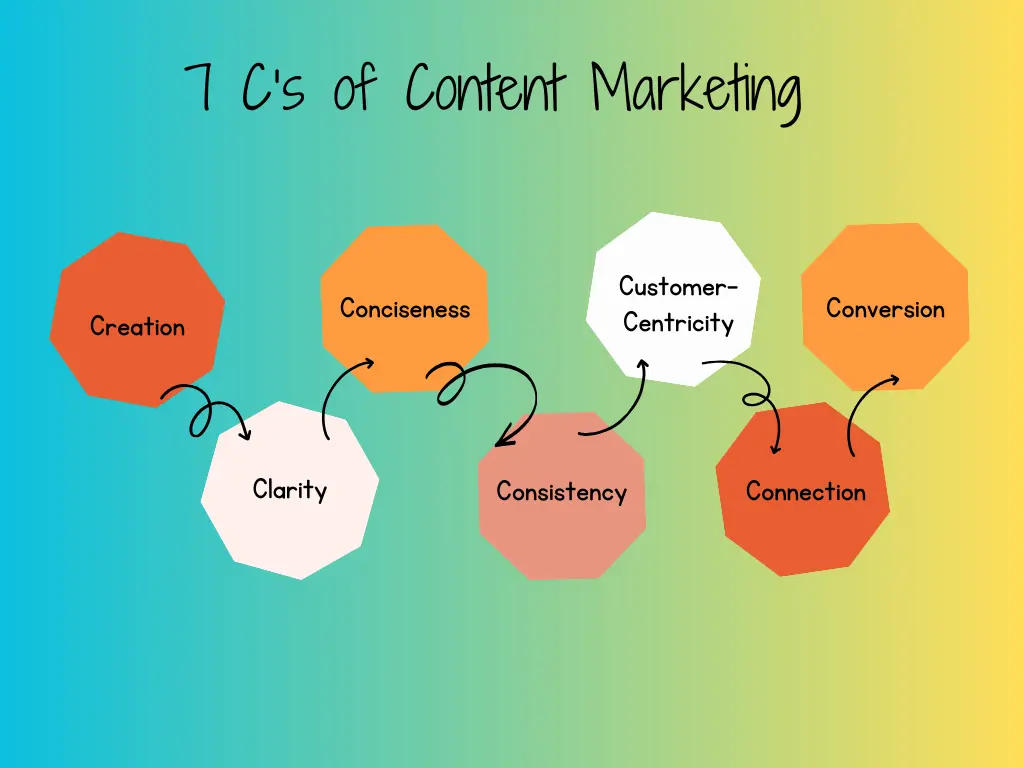
- Creation – There should be creativity in content development and produced content should be valuable and informative.
- Clarity – The content provided should be simple, direct, and easy to understand.
- Conciseness – The information given should be relevant and to the point using the fewest necessary words.
- Consistency – The content should be regularly published so as to create a trustworthy, and recognizable brand experience.
- Customer-Centricity – The central focus of your content should be your customer, i.e., customer’s needs and problems. It is about understanding your customer deeply and creating content that supports them, thus plays an important role in content marketing.
- Connection – The content should be made with a sense of building an emotional bond and trust with your customer.
- Conversion – The content should be made with an aim to increase conversions, i.e., the visitor should be made to take a specific action so that it becomes your customer. It can be understood as turning passive browsers or visitors into engaged participants or customers.
Our Link Partner- Ask Shashank Sir and Shark Mondo.
Some Common Content Marketing FAQs (Frequently Asked Questions)
How does Content Marketing different from SEO?
It is the creation of valuable content, while SEO refers to search engine optimization, the practice of optimizing a website’s content, structure, and technical performance to rank higher in organic (non-paid) search engine results. It helps search engines understand and connect your content with users, ultimately increasing visibility, driving traffic, and building online credibility. Both work best together, for instance, if SEO is the engine, Content marketing is the fuel.
How long does it take to see results?
Though it is not a quick fix, but with consistent efforts for typically 6-8 months, one can see the results.
What are the common Content Marketing mistakes?
Some Common mistakes are as follows-
- Lack of strategy
- Ignoring consistency
- Being too Promotional
- Weak brand storytelling
- Ignoring search intent
- Over-reliance on AI generated content
Are Content Marketing Courses beneficial?
Yes, its courses are highly beneficial as they provide essential skills in SEO, storytelling, and audience engagement often covering content strategy, creation, and analytics
Which brands are considered as the excellent examples of Content Marketing?
Brands that excel in it are as follows-
- Red Bull
- HubSpot
- GoPro
- Airbnb
- Coca-Cola, etc.
For more interesting content and updates follow us on The Visionary Beast.
Thanks for stopping by! Feel free to share your viewpoint by dropping a comment below.